
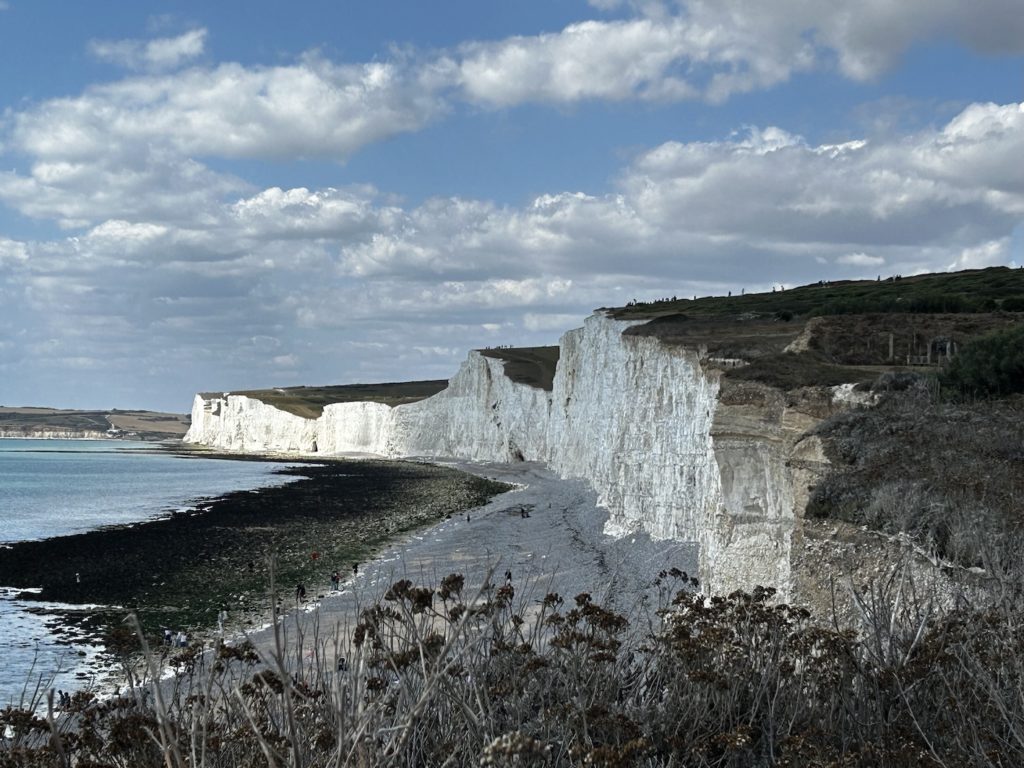
The RAF Bomber Command Memorial on Beachy Head.
The RAF Bomber Command Memorial, located on Beachy Head above the lighthouse. During the Second World War this was a frequent crossing point for bombers flying from their bases in the east of England en route to targets across Europe.
It was unveiled in 2012, just two weeks before the Queen unveiled the Royal Air Force Bomber Command Memorial in Green Park, thanks to the hard work of former RAF rear gunner Joe Williams, who, having completed twenty missions, was shot down over what is now the Czech
Republic in 1945.
Their Last View of England
The three crews on which Écrivélo focuses would have seen their last view of England along this
coast, although not directly at the Birling Gap.
The Admiral Prune, a Lancaster that crashed near Valsonne left RAF Syerston at ten minutes past six in the evening on the fourth of February 1943, part of a force of one hundred and eighty-eight aircraft bound for Turin in Italy. They flew south over Reading and crossed the coastline at Selsey Bill, eighty kilometres west of Beachy Head.
On the twenty-seventh of April 1944, the crew of the Worry Bird that crashed at Saint-Cyr-de- Valorges was one of twenty-one B-24 Liberators that took off from Harrington bound for drops to the French Resistance. They too crossed the coastline at Selsey Bill.
The Mosquito from 627 Squadron that crashed at Ternand on the night of the twenty-sixth and twenty-seventh of July 1944 took off at 23:14 from Woodhall Spa, in support of 171 Lancasters bound for the Marshalling Yards in Givors and followed a slightly different path to their target, crossing the coast at Bridport in Dorset, over two hundred kilometres west of the memorial. This roundabout route was necessary to avoid the fighting on the ground following the D-Day invasion fifty days earlier.
Then, England’s ground, farewell; sweet soil, adieu, My mother, and my nurse, that bears me yet!
Below them, England went dark. Not a light showing, nothing to steer by but the stars and each other. On these three planes, eighteen young men crossed this coast, carrying with them everything their countries still hoped to become. Eleven never saw home again. Of the seven who did, some would wait months, others years, before England was theirs to see again.