
A hamlet in the Rhône, a surgeon’s memoir, and one night in April 1944.
Eighty-two years ago today, on the evening of 22 April 1944, a man was carried into a private clinic somewhere in the Rhône*. He had been shot through the spine. He could not move his legs.
The doctor who examined him had never met him, and had not been told he was coming.
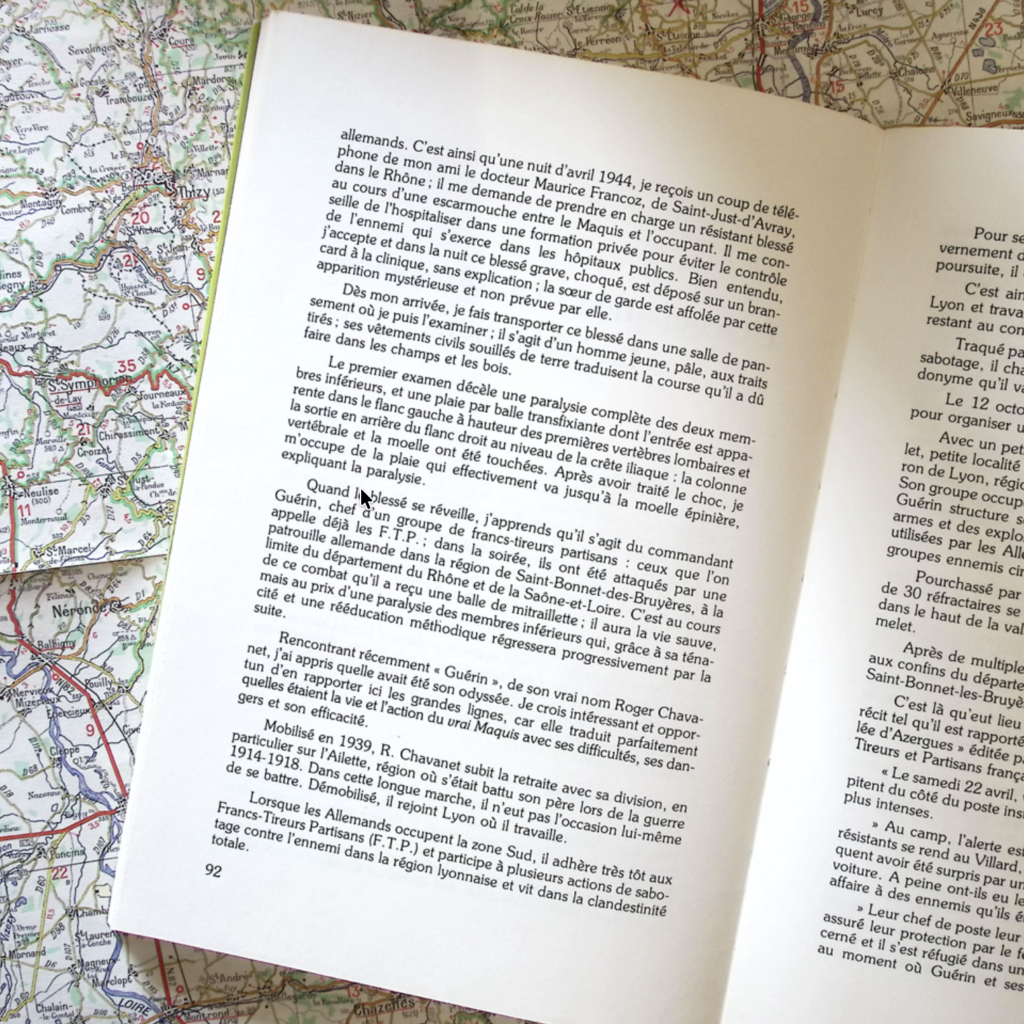
This is how Georges Arnult, a surgeon, opens the story in his 1981 memoir Un Chirurgien dans la Tourmente. He tells it almost in passing — a single page in a long book — but it is one of those passages that, once you know where it fits, rearranges everything around it.
*See sources
The Phone Call
Arnult’s account begins with a phone call. It is late on a night in April 1944. The caller is his friend Dr. Maurice Francoz, who practises in the village of Saint-Just-d’Avray. Francoz has a wounded Resistance fighter on his hands. The wound is serious. He cannot send the man to a public hospital, the Germans have informers and monitors in all of them. He asks Arnult to take the patient in privately.
Arnult agrees.
The patient arrives in the dark, on a stretcher, at a clinic where the sister on duty has no warning of his coming. She is, Arnult writes, affolée par cette apparition mystérieuse et non prévue par elle, bewildered by this mysterious and unexpected arrival. The man is pale, young, with the strained features of a long flight across fields and woods. His civilian clothes are stained with earth.
Arnult takes him to an examination room.
The Wound
The examination is precise, and the detail matters, because it tells you what kind of war he had been fighting.
A bullet has passed clean through him — entry in the left flank, exit in the right, at the level of the first lumbar vertebrae. The iliac crest is struck. The spinal column and the cord itself are involved. Both lower limbs are completely paralysed.
Arnult notes the wound from a bullet. When the wounded man regained consciousness, he describes it as from a submachine-gun.
The wounded man’s group had been ambushed the previous evening by a German patrol in the region of Saint-Bonnet-des-Bruyères, on the border between the Rhône and Saône-et-Loire. His group had not known the patrol was there. A short, brutal exchange of fire. He had taken the round and kept moving long enough to get out.
A name, and then another name
When the patient wakes, he gives his name.
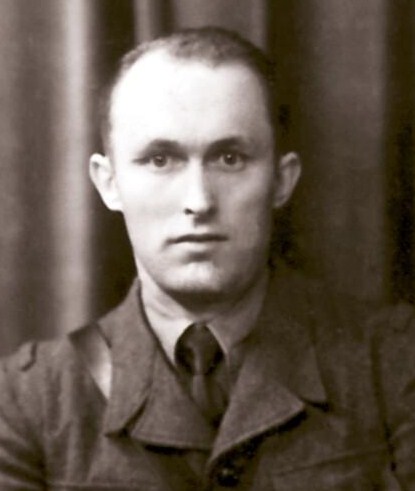
Commandant Guerin. Chief of a group of francs-tireurs partisans — the FTP, the armed wing of the Communist-led Resistance, which by April 1944 was running aggressive small-unit operations across the Beaujolais and the Lyonnais. Sabotage. Ambushes. Supply raids.
Arnult accepts the name and treats him.
It is only later, Arnult writes rencontrant récemment “Guerin” — meeting Guerin again recently — that he learns the name on the paperwork was a nom de guerre. The man’s real name is Roger Chavanet.
He had been mobilised in 1939. He had fought with his division on the Ailette, in Aisne, the same stretch of northern France where his father had fought in 1914–1918. After the demobilisation, he had returned to Lyon, where he worked. When the Germans occupied the southern zone in November 1942, Chavanet joined the FTP early, took part in multiple sabotage actions in the Lyon region, and lived in total clandestinity.
By April 1944 he was commanding his own group.
Until the patrol near Saint-Bonnet.
Dième
Chavanet lived.
The paralysis, Arnult writes, would “thanks to his tenacity and a methodical rehabilitation, progressively recede.” He walked again. And during the months it took to walk again, he and his family were hidden in a hamlet a few kilometres south of Chamelet, on a ridge above the Azergues valley.
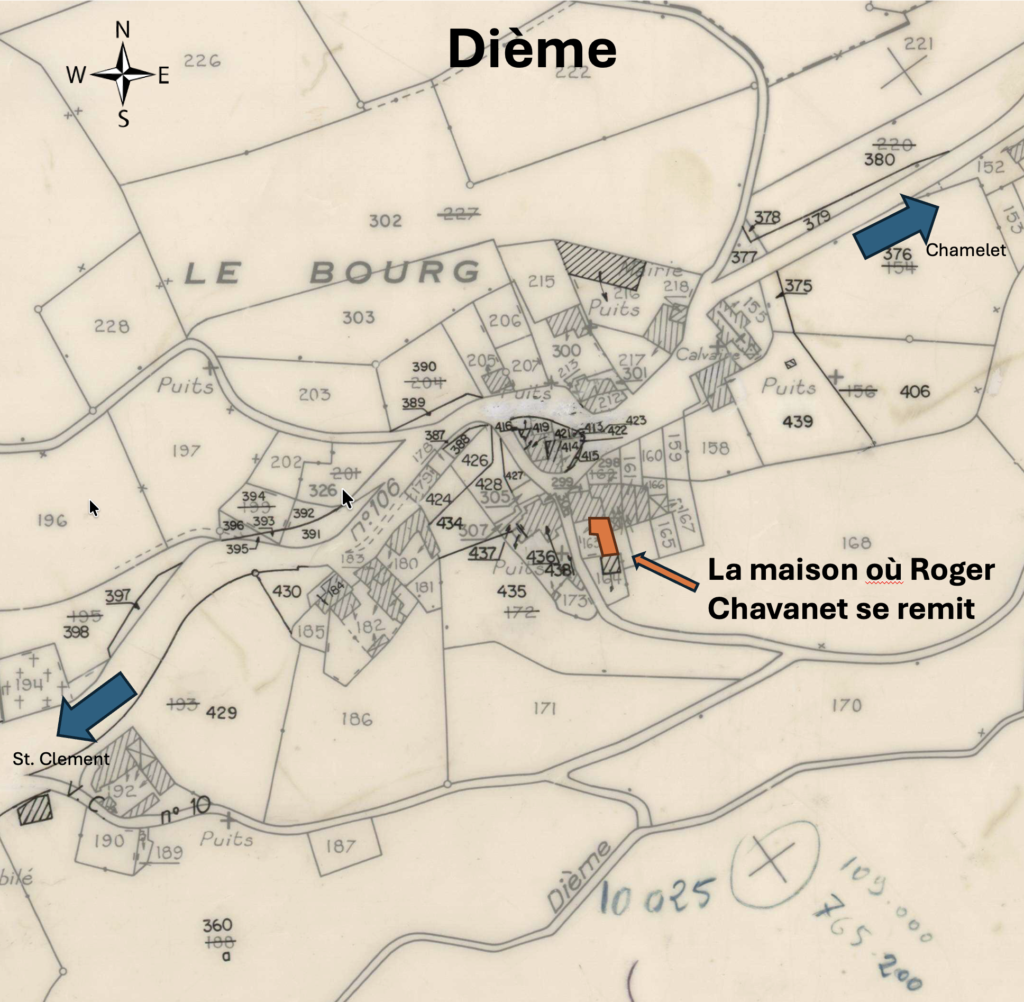
The hamlet is called Dième. Today it is a commune of fewer than two hundred people. In 1944 it was perhaps a dozen houses, a church, a calvary, and a web of walled gardens sloping toward the fields.
The house where Chavanet recovered is marked on the cadastral plan, held in the Departmental Archives of the Rhône. It sits in the south-central part of the bourg, between the road that climbs towards Chamelet and the track that drops south-west toward Saint-Clément. The plan was drawn up for the renewed cadastre of 1969 and updated in 1984. The building is still there.
He stayed in that house through the spring and into the summer of 1944. His wife Marguerite was with him. So was their daughter Liliane, eighteen months old when the family went into hiding.
Three of them, in a borrowed room, in a hamlet of a few dozen people, through the months when the war in France was entering its last and most violent phase.
Sources and References
- Georges Arnult, Un Chirurgien dans la Tourmente, Éditions Lavauzelle, Paris–Limoges, 1981, p. 92.
- Plan cadastral de la commune de Dième, Section AB. Archives départementales du Rhône, Cote 06609, 5565W40. Plan renouvelé pour 1969, édition à jour pour 1984. Producteur : Rhône, Direction départementale du cadastre.
- Roger Chavanet (alias Guerin), Histoire vécue des maquis de l’Azergues (Lyon: Imprimerie Rivet, 1989), p137.
-
As for the hospital where Chavanet was treated, Arnult’s biography (cited above) records that he worked at the Clinique Claude Bernard in Lyon. However, in the biography of Chavanet, he states that he was treated at the Clinique Saint-Maurice.
Photograph and annotated map: the author, from a visit to Dième on 22 April 2026 — eighty-two years to the day after the events described above.
This post is also available in:
 Français